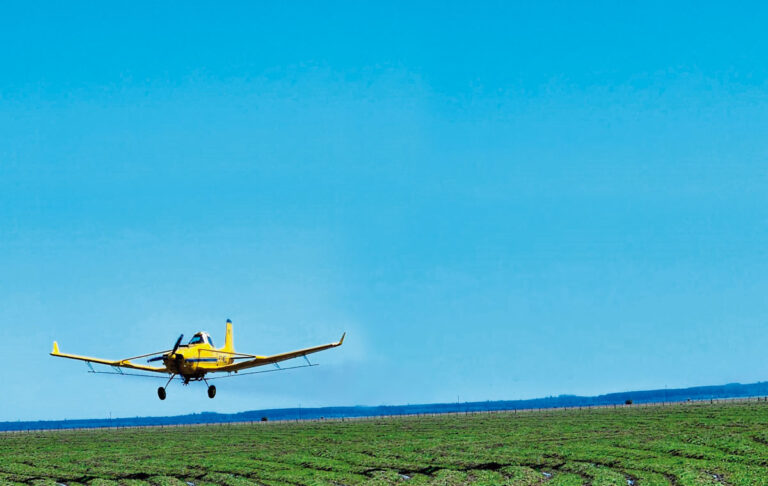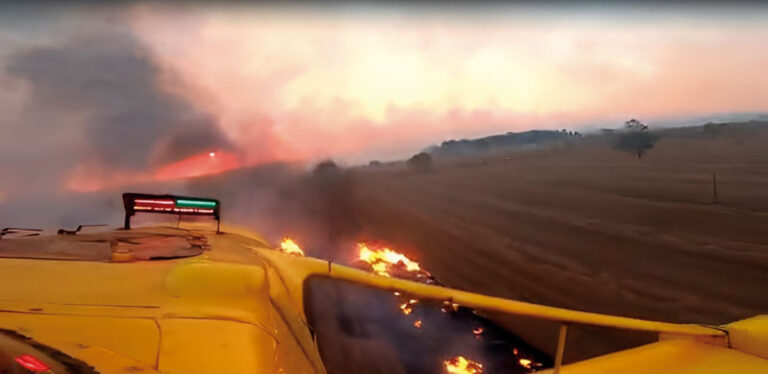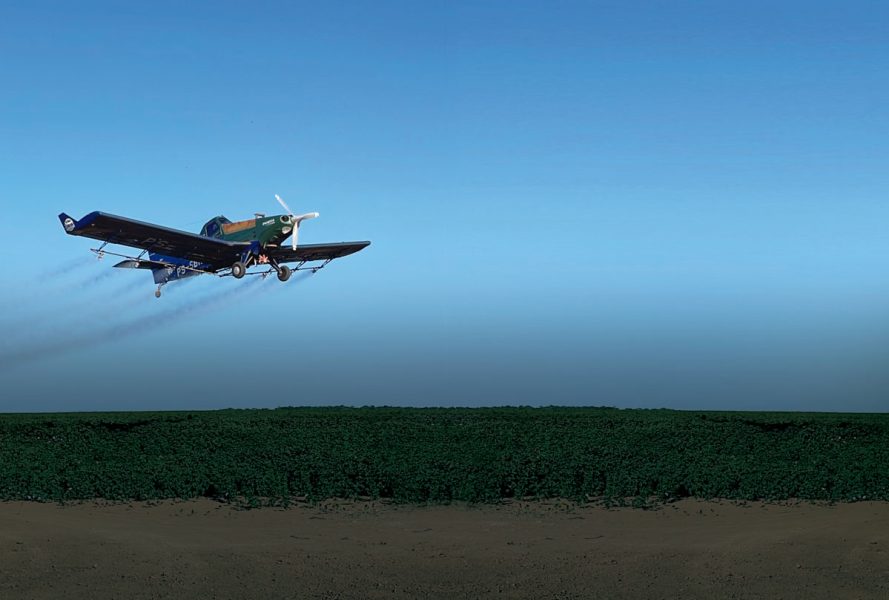

Limited budgets, high interest rates, and uncertainties in the global macroeconomic scenario are some of the challenges expected to permeate the 2025/2026 harvest. “The current moment calls for crunching numbers in search of tools that help reduce production costs,” ponders the president of the Brazilian Institute of Agricultural Aviation (Ibravag), Júlio Augusto Kämpf. To this end, the entity is promoting a campaign to expand the use of the tool in fields by encouraging service outsourcing.
Kämpf understands that technology can be a vital ally for producers when it comes to balancing the books with profitability. Outsourcing spraying services appears as a solution to implement state-of-the-art technology in the field without immobilizing capital. Agricultural pilot and businessman Caio Balzan highlights that hiring aerial spraying services is “fundamental” for producers seeking efficiency without the costs and responsibilities inherent in operating their own aircraft.
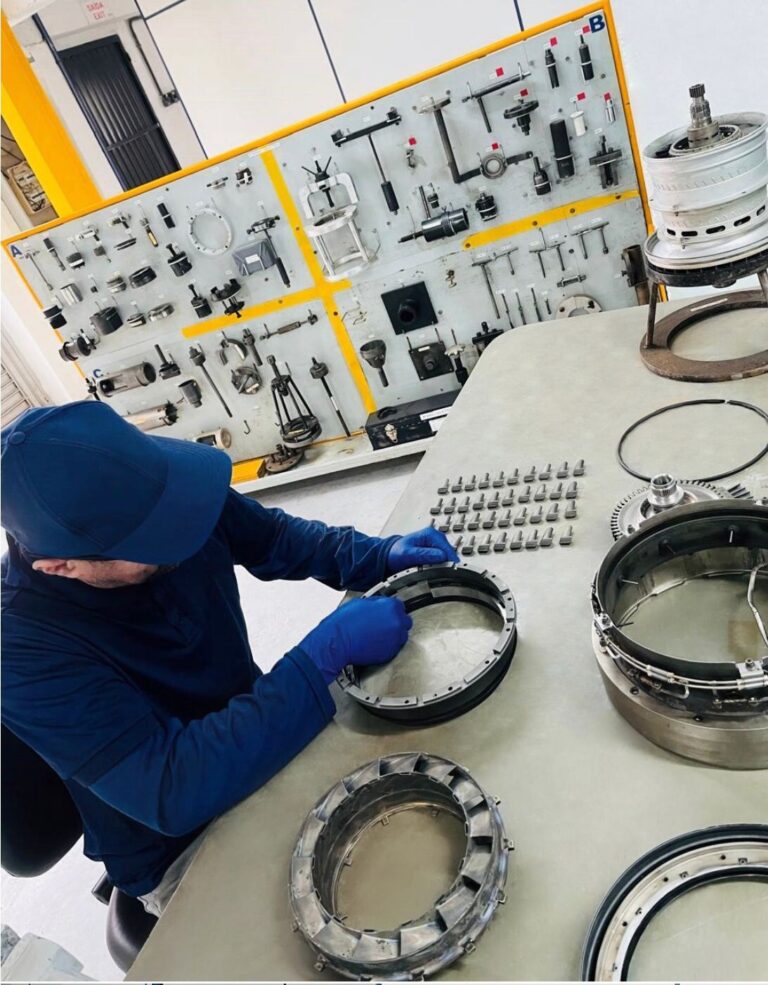
According to Balzan, the first major benefit of outsourcing is access to specialized knowledge. “Operational, tax, and maintenance requirements are enormous. Due to a lack of knowledge, many producers end up frustrated after buying a plane when they realize the complexity and cost of the process,” says the commercial operator.
REQUIREMENTS
According to the executive director of the Mossmann Group, Cléria Regina Mossmann—who holds a Master’s in Agribusiness and expertise in documentation management—aero-agricultural operators must provide information about their operations to nine regulatory and/or supervisory bodies. This list includes the National Civil Aviation Agency (Anac) and the Ministry of Agriculture and Livestock (Mapa), which are responsible for standardizing the activity. Additionally, some municipalities have their own rules regarding the activity.
Also factored into this equation is the requirement for qualified professionals. In addition to the agricultural pilot, operating the tool requires an agronomist and an agricultural technician with courses as Coordinator (CCAA) and Executor (CEAA), respectively—both approved by Mapa. Those providing services with drones must prove completion of the Remote Aero-agricultural Application Course (CAAR).
These obligations bring much-needed transparency to the aero-agricultural service—and even to private operators (farm owners with their own aircraft)—at a time when the world’s eyes are turned toward environmental and social sustainability. “The outsourced model reduces fixed costs, optimizes capital use, and ensures high technical, environmental, and operational standards in input applications,” points out the executive director of Ibravag and the National Union of Agricultural Aviation Companies (Sindag), Gabriel Colle.
| Entity / Obligation | Commercial Operator (Aero-agricultural Operator) | Private Operator (Farms with own aircraft) |
|---|---|---|
| Anac: National Civil Aviation Agency | ||
| Have updated and valid CDAG | ☒ | |
| Designate and register an Accountable Manager | ☒ | |
| Have Certificate of Registration (CM) for the aircraft | ☒ | ☒ |
| Have a valid Certificate of Airworthiness (CA) | ☒ | ☒ |
| Have a qualified agricultural pilot (per RBAC nº 61) | ☒ | ☒ |
| Record equipment maintenance (tanks, pumps, GPS/DGPS), flight reports, and operational safety | ☒ | ☒ |
| Keep registration information updated with the agency | ☒ | |
| Follow the Best Practices Guide for Aero-agricultural Operations | ☒ | ☒ |
| Provide operation and equipment manuals, technical publications, and service bulletins to pilots and technical staff | ☒ | ☒ |
| Mapa: Ministry of Agriculture and Livestock | ||
| Keep registration information updated, including professionals involved | ☒ | ☒ |
| Meet the requirements of IN nº 2/2008 | ☒ | ☒ |
| Use approved equipment for agricultural aircraft | ☒ | ☒ |
| Keep operational application reports archived for at least 2 years, along with complementary documents (agronomic prescriptions and application maps) | ☒ | ☒ |
| Decea: Department of Airspace Control • Comaer: Air Force Command | ||
| Request airspace use authorization | ☒ | ☒ |
| Register a flight plan for each operation | ☒ | ☒ |
| Observe area and route restrictions | ☒ | ☒ |
| Ibama: Brazilian Institute of the Environment and Renewable Natural Resources • IN nº 13/2021 | ||
| Active registration in the Federal Technical Registry (CTF/APP) | ☒ | ☒ |
| Operations with manned aircraft must record activities: | ||
| Aerodrome Operation | ☒ | ☒ |
| Application of Pesticides and Similar Products | ☒ | ☒ |
| Documents issued: | ||
| Proof of Registration in CTF/APP | ☒ | ☒ |
| Certificate of Regularity | ☒ | ☒ |
| Suasa: Unified System for Attention to Agricultural Health — State Plant Defense | ||
| Register the company with the state plant defense agency of operation | ☒ | |
| Compliance with current state regulations in the operation region | ☒ | ☒ |
| Attend to additional requirements, such as sending reports or changes in safety distances. Ex: INDEA-MT | ☒ | ☒ |
| CREA: Regional Council of Engineering and Agronomy | ||
| Professional registration of the agronomist and issuance of ART | ☒ | ☒ |
| Issuance of registration certificate, maintenance of fees and company registration info | ☒ | Only when the private operator is a legal entity |
| Note: Professional and company registration must be requested in all States of operation | ||
| CFTA: Federal Council of Agricultural Technicians | ||
| Professional registration and issuance of TRT | ☒ | ☒ |
| Issuance of registration certificate, payment, maintenance of fees and registration info | ☒ | Only when the private operator is a legal entity |
| Fire Department | ||
| Fire and Panic Safety Plan (PSCIP) for facility approval (hangar, runway). Smaller rural areas may be exempt or use simplified inspection. | ☒ | ☒ |
| Occupational Health and Safety | ||
| PCMSO (NR-7) – Occupational Health Medical Control Program | ☒ | ☒ |
| PGR – Risk Management Program | ☒ | ☒ |
| LTCAT (NR-15) – Technical Report on Working Environment Conditions | ☒ | ☒ |
| Hazardous/Unhealthy Work Reports – indicate additional payments and prevention measures | ☒ | ☒ |
| SST – Health and Safety at Work information sent monthly via eSocial | ☒ | ☒ |
On-demand technology: a strategic solution for agribusiness

Professor Dr. Regina Pagani says that the topic of outsourcing in agribusiness gained more prominence starting in 2017.
Photo: Personal archive
In a current scenario marked by high credit costs and climate uncertainties, outsourcing in agribusiness emerges as a strategic solution for rural producers. Dr. Regina Negri Pagani, a professor in the Graduate Program in Production Engineering at the Federal Technological Institute of Paraná (PPGEP/ITFPR), believes that hiring specialized services—including agricultural aviation—can be an effective alternative path to mitigate risks and reduce production costs.
Advisor for the dissertation “Outsourcing in Agribusiness: A Current Overview” by PPGEP/ITFPR student Sabrina Aparecida Pereira, Professor Regina emphasizes that literature on the subject in Brazil is still scarce. Research conducted in 2021 points out that studies on outsourcing in the field gained more academic interest from 2017 onwards, potentially motivated by expanded discussions related to Industry 4.0 and precision agriculture.
As the daughter of rural producers, Regina understands that the cost of outsourcing services is a concern, but over time, producers will realize it is not that high compared to the direct costs of ownership. To reduce this expense, she suggests adopting alternatives, such as creating a cooperative system for courses, training, and a better understanding of new technologies, their uses, and benefits.
Additionally, she reminds: “when I outsource, I pay to use the technology at the moment I need it, eliminating costs with technology used sporadically.” Thus, the producer avoids expenses such as: machine storage costs; maintenance costs; depreciation; and the need to hire a qualified operator exclusively year-round.
Operational complexity requires specialized professionals
Caio Balzan warns about the risk of lack of knowledge in operating high-end technology.
Photo: Serrana Aviação Agrícola Archive
The director of Serrana Aviação Agrícola, agricultural pilot Caio Balzan, understands that the trend is for professionalization and increased operational complexity to lead more farms toward outsourcing. He warns that when talking about high-end technology like agricultural aviation, the risks of operating equipment without technical mastery and adequate infrastructure can compromise operational safety.
Arguments in favor of producers outsourcing aerial applications start with access to specialized professionals, followed by the efficient use of the climate window. According to Balzan, outsourcing does not leave the producer limited to their fixed asset. “If the weather window tightens, he calls the operator and asks for another aircraft. He doesn’t need to compromise application quality to justify the investment,” he points out. The same applies to increases in demand.
Another argument highlighted by the aero-agricultural businessman concerns maintenance. “The producer only pays for the service. If there is a turbine problem, if the plane is damaged, or if a $70,000 part needs to be replaced, that is the operator’s responsibility, not the farm’s,” says Balzan.
Although there is not yet an exact percentage of savings when outsourcing application services, Balzan states that the hidden cost of an idle plane, added to fixed expenses and operational risks, makes own acquisition a difficult bill to justify.
Despite the advantages of outsourcing and, according to Balzan, the hiring movement remaining heated in his area, the sector faces a recurring problem: closing deals based exclusively on price. “The contractor often doesn’t know how to evaluate if the application was done with quality. If we can teach the producer to supervise the service—pre and post-application, map analysis, technical parameters—companies that work inadequately will be forced to adjust,” Balzan states.
Valuing specialized service on the agenda

Rodrigo de Faria points out the need for operators to know how to sell their services better, showing their differentiation.
Photo: Jusarah Agro Aéreo Archive
For the director of Jusarah Agro Aérea, agricultural pilot Rodrigo de Faria, entrepreneurs in the sector need to learn how to sell their work better. This is fundamental at a time when labor scarcity is dictating the pace of global growth, especially in the service sector—the one that most drives agribusiness. “However, the sector has a high cost for infrastructure and logistics to deliver a quality and competent application,” reinforces the operator.
It is precisely this entire engine, with specialized professionals meeting all regulatory requirements—including agronomists, agricultural pilots, flight coordinators, and execution technicians—that will be made available to the contractor to generate the expected result: effective plant treatment. This is not even counting aircraft with high-end onboard technology.
TRUST
“The DNA of an aero-agricultural operator is performing aerial applications of inputs on crops, and this is worked on year-round, not just during the harvest of a specific crop, as happens on farms,” explains Faria. This differentiation, which includes high salaries compared to the Brazilian average, continuous update courses, and news in application technology, needs to be considered when closing a contract.
Therefore, he understands that it is essential for operators to know how to negotiate and dialogue with contractors so they have a real reading of where companies in this field can and want to go. To this end, Faria reinforces: “It is very important for the client to feel trust, which is only transmitted through deep knowledge of the techniques and technologies associated with the activity.”
Producer compares cost/benefit of aerial application
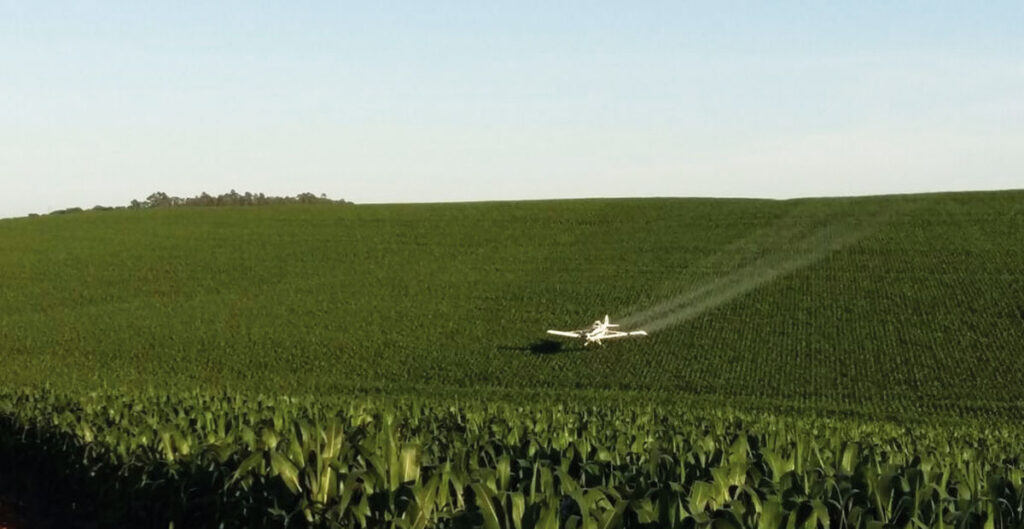
The farm has used agricultural aviation for seven years for crop care due to its speed and for avoiding crop trampling.
Photo: Fazenda Predebon Archive
Concerned about rising costs year after year, rural producer Gustavo Predebon has agricultural aviation as a major ally. For at least seven years, Fazenda Predebon in Quatro Irmãos/RS has hired the specialized service. According to the manager, the idea is to offset costs with increased yields. “The tool avoids losses and maintains productive potential,” he says.
Now, Predebon has started an unprecedented experiment on the property: managing a 60-hectare plot of corn with 100% of applications done by agricultural planes and comparing the results with a neighboring area managed traditionally—using a mix of ground and aerial spraying.
The project, developed in partnership with Aerodinâmica Aviação Agrícola from Erechim/RS, is supervised by agronomist Daiani Brandler for the operator and farm agronomist Luciano Remor. “We are going to put everything on paper and see what the difference will be between agricultural aviation and the area where there were mixed applications—ground and aerial,” he states.
Results will only be known in April when the corn is harvested. In the next agricultural year, the producer intends to repeat the experiment with soybeans to generate comparative data. Unlike corn, which is a tall crop that makes aerial operation indispensable after a certain stage, in soybeans, it is possible to have one plot with only aerial applications and another with only ground applications.
PLANNING
The goal of the agricultural aviation experiment is simple: to preserve the profitability of the farm producing soybeans and corn in the summer, and wheat, oats, and rye in the winter. “The cost rises year after year and the margin gets smaller and smaller,” says the producer. Inputs like urea, fertilizers, and limestone also pressure the budget. Thus, the results will serve as a basis for planning the 2026/2027 harvest.
The full evaluation will be done after the corn harvest in April. “We want to measure precisely if agricultural aviation pays off through time gains, reduction in trampling, and possible productivity increases,” explains Predebon. However, even before data collection, Predebon, who took over farm management four years ago, highlights the qualities of agricultural aviation.
Speed is one of the factors he considers very important for allowing application in the best climate window. “What I take two days to do with a ground sprayer, the plane does in three hours, sometimes less. It is very practical for us,” Predebon concludes.